
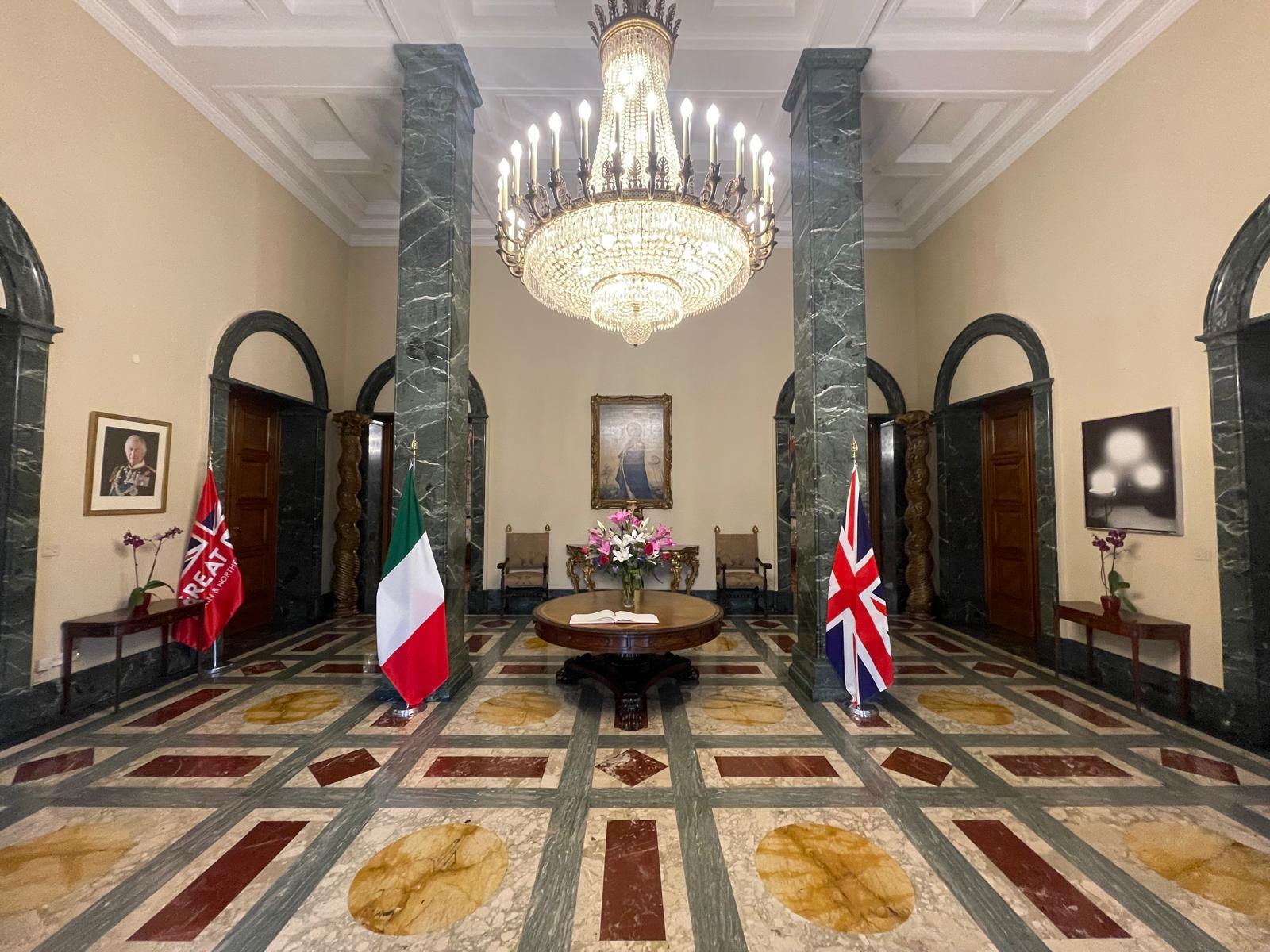
Villa Wolkonsky, Rome
Hosted at Villa Wolkonsky, the British Ambassador's Residence in Rome, StateUp recently convened a UK–Italy roundtable with the Foreign, Commonwealth & Development Office, and the UK Science & Technology Network on Quantum, AI, and High-Performance Computing (HPC). The discussion focused on where bilateral cooperation can move from intent to implementation—through shared infrastructure approaches, targeted programmes, and practical partnership models.
AI, Quantum, and HPC are converging. HPC provides the backbone for large-scale computation; quantum technologies accelerate specific optimisation and simulation tasks; AI orchestrates models and workflows across both.
Both countries bring complementary assets. Italy operates two of the most powerful supercomputers in the world: Leonardo at CINECA, ranked tenth globally, and HPC6 at Eni's Ferrera Erbognone facility, ranked sixth. The UK holds the third-highest number of AI companies globally and has committed more cumulative public quantum funding than any other European country. Yet collaboration, though meaningful, remains largely ad hoc. Joint publications across the three fields together represent roughly 10% of each country's research output. This is a significant foundation, but is often built on personal networks rather than institutional frameworks.
Policy alignment is stronger than the level of joint activity reflects. The UK and Italy are converging in their critical technology strategies, the UK through large-scale instruments such as the £2 billion Quantum Leap package and AI Growth Zones, Italy through infrastructure platforms that explicitly couple AI, HPC, and quantum capability.
Complementarity is most valuable when it is purposeful. The UK's AI research depth and Italy's world-class compute infrastructure are most valuable in combination when applied to specific shared challenges, climate modelling, drug discovery, advanced materials, secure communications, rather than as parallel national programmes with occasional joint activity at the margins.
The barriers are identifiable. Post-Brexit friction, particularly the international tuition fee regime, was cited as a significant structural obstacle. "If a visiting student comes for more than three months, they have to pay the international fee as if they were enrolled — exchanges with students have become practically impossible," observed one UK participant. Most partnerships remain informal and project-by-project.
Discussions and analysis identified five areas where targeted investment would shift the partnership from intent to structured cooperation.
Shared infrastructure access. Reciprocal preferential access to flagship platforms, including Italy's Leonardo and CINECA facilities for UK researchers and UK national quantum testbeds and quantum hubs for Italian teams. This collaboration could lower the transaction costs of building competitive joint bids for EuroHPC and Horizon calls.
Early-career mobility. The UK-Italy Trustworthy AI Visiting Researcher Programme demonstrates the model: 36 short exchanges generating approximately 70 joint outputs at an average cost of around £2,400 per exchange. Scaling this across quantum and HPC, alongside targeted scholarship support to offset international fee barriers, could expand the people-to-people networks on which large-scale cooperation depends.
Horizon preparation. Small pump-priming seed grants to build binational consortia and prepare bids ahead of key European calls. As one expert noted: "Having a grant-supported collaboration would be more beneficial. It wouldn't just be 'I send you the sample, and you study it' — but something we do together."
A joint scientific steering group. A UK-Italy committee on AI, quantum, and HPC, would provide the institutional architecture currently missing: a mechanism for setting shared 2–3 year priorities, monitoring progress, and raising cooperation to the visibility it warrants.
Moonshot programmes. The recently concluded €211 million Italian state investment in CamGraPhIC, a Cambridge spinout developing graphene-based photonic transceivers, illustrates appetite and scale. Quantum-enhanced AI for critical infrastructure, energy grid optimisation, financial system resilience, advanced materials simulation, was identified as a high-value area for UK-Italy leadership.
StateUp is continuing its work with partners in both countries to develop the programme of cooperation identified through this process. A fuller analysis of the opportunity landscape, current barriers, and recommended next steps will be available soon.
If your work touches UK-Italy technology cooperation, critical technology strategy, or international partnerships, we'd welcome the conversation — hello@stateup.co
.jpg)
.jpg)


